




English Willow vs Kashmir Willow Bats: Which Should You Buy for Your Level, Ball Type and Budget?

English willow vs Kashmir willow bats: match the wood to your level, ball type and budget in 2026. Honest, practical buying advice from Highmark Cricket.
Buy English willow if you play regular leather-ball cricket, and Kashmir willow if you mostly play with a tennis, synthetic or taped ball. English willow is lighter for its size and gives better rebound, but it needs preparation and costs more. Kashmir is denser, harder and cheaper, but heavier and less lively.
Most comparisons of English willow versus Kashmir willow bats read like a botany lesson. That is not the question a parent or player is asking. The real question is simpler: which bat suits this player, right now, for the ball they will actually face?
I have a firm view on this, shaped by years of talking to players, coaches, clubs and schools. The best bat is the one suited to your level and playing style, not just the most expensive option. A Grade 1 English willow is wasted on a backyard tennis-ball game. A Kashmir bat will hold back a committed club batter. This guide helps you work out which side of that line you are on.
Key Takeaways
- Ball type is the biggest factor. Leather-ball cricket generally calls for English willow. Tennis, synthetic and taped balls are well served by Kashmir willow.
- English willow is the lighter, livelier wood. Kashmir willow is denser and typically heavier at the same size.
- A junior should step up to English willow when they start playing regular hard-ball club cricket, not before.
- Entry grades of English willow are often smarter than top grades, especially for growing players.
- English willow needs proper knocking in and oiling before it meets a leather ball. Kashmir willow usually asks for less, but follow the maker's instructions.
- Buy for your current level and ball. Do not buy for a level you might reach in three years.
The Short Answer: A Quick Decision Table
This table gives a starting point by player type. It is qualitative on purpose. Prices change by brand and season, so check the current catalogue for exact figures.
| Player type | Ball used | How often they play | Budget approach | Suggested willow |
|---|---|---|---|---|
| Young child, first bat, backyard or park | Tennis, soft or synthetic | Occasional | Keep it low | Kashmir willow, or a junior kit |
| Junior at school or social level | Tennis or mixed | Weekly | Low to moderate | Kashmir willow, or an entry-grade English willow if leather is coming soon |
| Junior moving into hard-ball club cricket | Leather | Weekly games plus training | Moderate | Entry-grade English willow |
| Social adult, beach or backyard cricket | Tennis or taped | Occasional | Keep it low | Kashmir willow |
| Social adult, weekend leather-ball cricket | Leather | Weekly | Moderate | Lower-grade English willow |
| Committed club batter | Leather | Several sessions a week | Moderate to higher | English willow, with grade set by budget and feel |
| Rep or pathway player | Leather | Frequent | Higher | Higher-grade English willow, chosen for pickup and balance |
The rest of this article explains the reasoning behind each row.
What Is English Willow?
English willow is the wood used for almost all serious leather-ball cricket bats. It comes from Salix alba caerulea, commonly called cricket bat willow, grown mainly in England. It is a soft, light, fibrous timber that absorbs impact and returns it well.
According to the Wikipedia entry on Salix alba (https://en.wikipedia.org/wiki/Salix_alba), the cricket bat willow is a cultivated variety of the white willow. It is grown in managed plantations, often near water, and harvested after many years of growth. That slow supply is one reason English willow costs more.
Why grades exist
Bats cut from English willow are sorted into grades, typically Grade 1 down to Grade 4 or lower, though naming varies by brand. Grading is mostly about appearance: the number and straightness of grains and the amount of blemishes or marks on the face. Top grades look cleaner and are usually more selectively sourced.
A higher grade does not guarantee better performance. Two bats of the same grade can feel quite different, because every piece of timber has its own density, weight distribution and pickup. That is why matching the individual bat to the player matters more than chasing a grade number.
Why it needs preparation
English willow is soft-fibred. That softness is what gives it spring, but it also means a raw bat is vulnerable to a hard leather ball. The fibres need compressing and the surface needs protecting before match use. We cover that in the preparation section below.
What Is Kashmir Willow?
Kashmir willow is the timber from willow grown in the Kashmir region of India. It is also a type of willow, but it is denser and harder than English willow. It is widely used for entry-level and tennis-ball bats, and for bats where low price and toughness are the priorities.
Because the wood is denser, a Kashmir bat is typically heavier than an English willow bat of the same size. The extra density also means less natural spring. The ball comes off the blade with less of the lively pop that good English willow delivers.
That does not make Kashmir willow a poor product. It makes it a different product. For a soft ball that never needs that rebound, it is often the more sensible purchase. It is also usually kinder on the budget, which matters when a child will outgrow the bat in a season or two.
Availability of Kashmir willow varies, so it is worth asking what is currently in stock before you decide.
How the Two Woods Differ in Practice
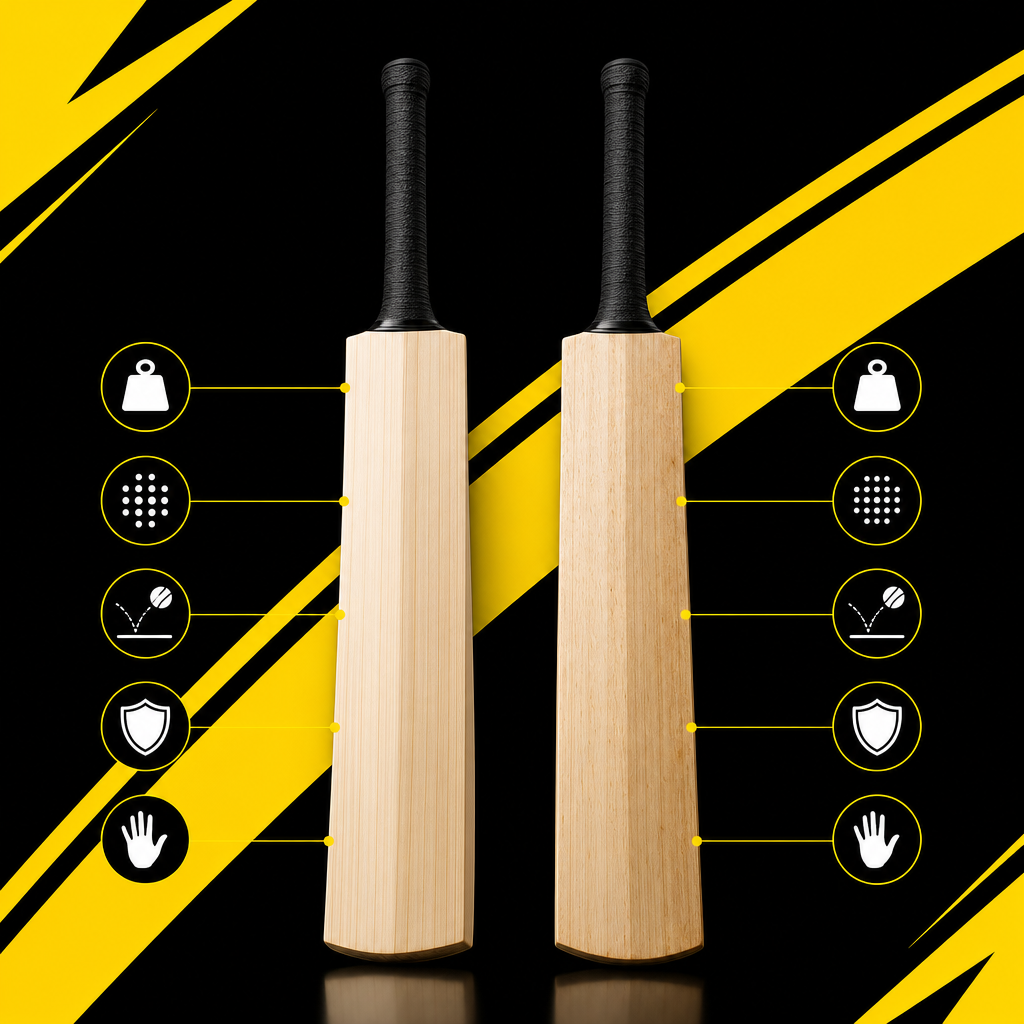
In practice, English willow is lighter, springier and more responsive, while Kashmir willow is denser, heavier and harder-wearing against soft impacts. The differences show up in four places: weight for size, rebound, durability and feel. Here is each one in plain language.
Weight for size
Density decides how heavy a bat feels at a given size. Kashmir willow is denser, so a Kashmir bat is typically heavier than an English willow bat of the same dimensions. For an adult that may just feel solid. For a child it can be the difference between a bat they can swing freely and one they have to muscle around.
A heavy bat tends to pull a young player into poor habits, such as dragging the bat through with the bottom hand or struggling to get it up for a straight backlift. Weight is one of the reasons we are cautious about putting juniors in oversized or heavy bats. Our companion guide on cricket bats by size, weight and player level goes into sizing in more depth.
Rebound and ping
English willow's lighter, more elastic fibres compress on impact and spring back, which is the lively sound and feel batters call "ping". Kashmir willow is stiffer and returns less energy. With a tennis ball you will barely notice. With a leather ball, a batter who is timing it well will notice the gap.
Durability
Many articles say Kashmir willow lasts longer. That is only half true. Kashmir is harder, so it resists surface dents from soft balls well. But durability depends on matching the bat to the ball and preparing it properly. A well-prepared English willow bat used with a leather ball will give years of service. A poorly prepared one can crack in a few overs.
Feel
Feel is where experienced batters notice the most. English willow tends to feel alive in the hands, with more feedback on contact. Kashmir tends to feel dead and solid. A beginner may not care. A club batter who has used English willow will.
Ball Type Matters Most
Ball type should be your first filter. Leather-ball cricket generally calls for English willow, because the wood is built to absorb and return the impact of a hard, heavy ball. Tennis, synthetic and taped balls are lighter and softer, so Kashmir willow handles them well and costs less.
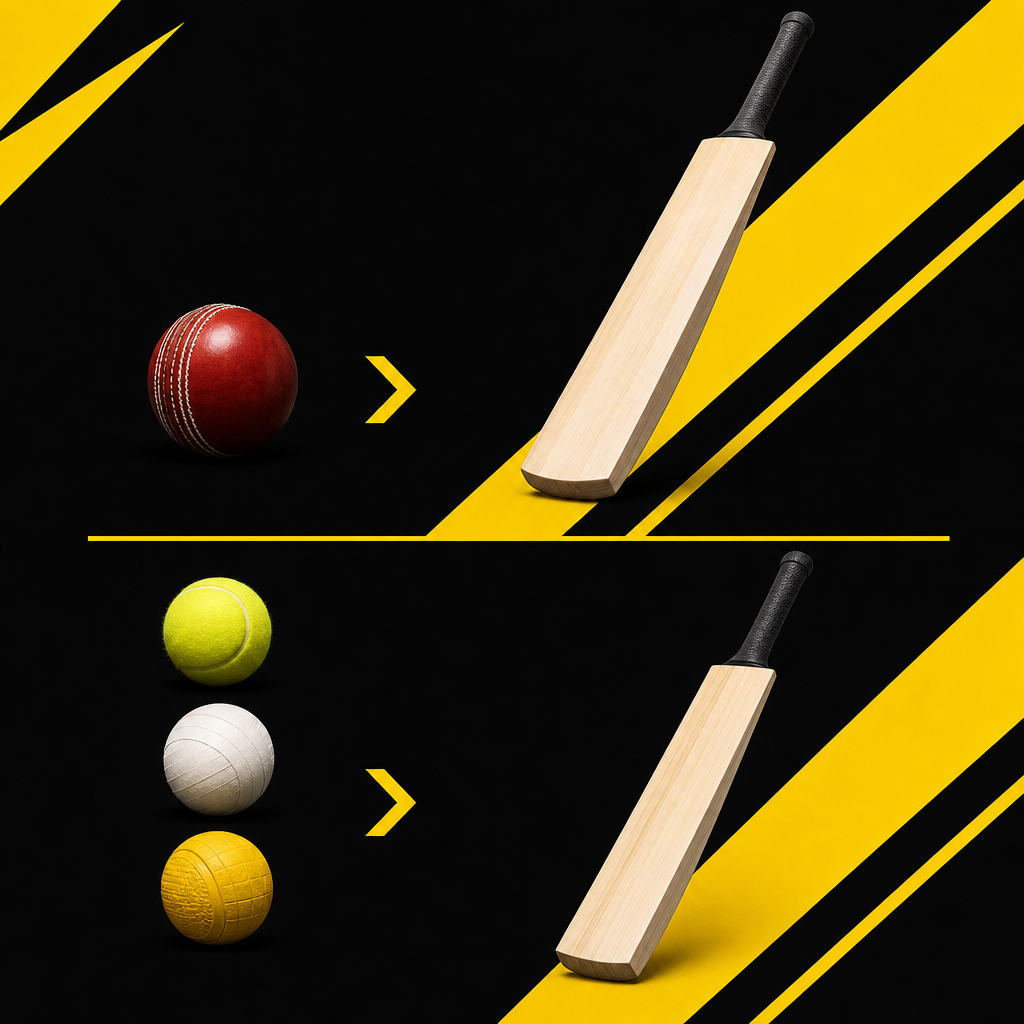
Hard ball vs tennis ball cricket bat
The phrase "hard ball vs tennis ball cricket bat" gets searched often because the two games ask different things of a blade.
A leather ball is dense and travels fast. It puts concentrated force into a small area of the bat. English willow is designed for that: the fibres compress, spread the load and spring back, provided they have been knocked in.
A tennis ball, a taped tennis ball or a synthetic ball is far lighter and softer. It delivers a fraction of that force. The bat does not need to be springy or finely prepared to cope. You are paying for performance the ball cannot use.
What goes wrong when you mismatch
There are two common mismatches, and both cost money.
English willow with a leather ball, unprepared. This is the classic cracking scenario. A raw, unoiled, un-knocked-in English willow bat meets a hard ball, and the soft fibres split or splinter along the face or toe. Good preparation prevents most of this. A premium bat is no exception.
Kashmir willow with a leather ball, used seriously. This does not usually end with a dramatic crack. It ends with a bat that feels heavy and flat, gives less rebound and holds the batter back. Over a season, a committed player loses the benefit of timing a good shot because the wood returns less energy.
English willow with a tennis ball. The bat will survive. The issue is value. You have paid a premium for properties the ball cannot use, and a premium bat can pick up scuffs and marks from rough surfaces and tape that no club batter wants on a bat they love.
Making the right match is the simplest way to protect both your bat and your budget. The rules of the game also set one boundary: according to the MCC Laws of Cricket (https://www.lords.org/mcc/the-laws-of-cricket), the blade of the bat must be made solely of wood. Both English and Kashmir willow comply, so legality is not the issue. Suitability is.
When Should a Junior Step Up to English Willow?
A junior should step up to English willow when they begin playing regular hard-ball club cricket, usually in a junior competition where leather balls are used in matches and training. Before that point, a Kashmir bat or a junior kit is usually the better value.
The age at which players move to a hard ball varies by association and by format, so ask your club what applies. The decision rule is not age. It is the ball. If your child is facing leather most weeks, an English willow bat is the right tool. If they are still on tennis or soft balls in the backyard and at school, it is not needed yet.
English willow cricket bat for juniors: what to look for
If you are buying an English willow cricket bat for juniors, keep these priorities in order:
- Correct size. A bat that is too big hurts technique more than any wood choice helps it. Check height-based sizing and handedness before you look at grades.
- Manageable weight. Pick the bat up and judge pickup, not just the label weight. Two bats with the same listed weight can feel very different because the balance is different.
- Suitable grade. Entry grades are usually enough.
- Realistic lifespan. Juniors grow. A bat that fits well this season may be the wrong size within a year or two.
If you are searching for the best cricket bat for beginners, the honest answer depends on the ball. For a true beginner with a soft ball, a Kashmir willow bat or a junior kit is usually the best cricket bat for beginners. For a beginner entering a leather-ball junior competition, an entry-grade English willow bat in the correct size is the better starting point.
Why entry grades are often smarter than top grades
Grade is mainly about looks. The cleaner face of a top-grade bat is attractive, but it does not make a 10-year-old hit the ball harder or time it better. What improves a junior's batting is a bat that fits, is well prepared and is used often.
Entry and mid grades of English willow give you the real benefits of the wood: lighter weight, better rebound and the right feel for a leather ball. The premium you pay for a top grade is largely cosmetic for a growing player who will need a larger size soon. We would rather see a family put that money into a good protective set, coaching or the next size up.
Cricket sets and junior kits also deserve a look for younger players. They bundle a suitably sized bat with other gear, which can make sense for a first season.
Preparation and Care: What Each Wood Needs
English willow needs proper preparation before match use: light oiling, knocking in with a mallet to compress the fibres, and protection for the face and edges. Kashmir willow generally needs less, though you should follow the maker's instructions. Both benefit from sensible storage and care.
English willow
A new English willow bat is not match-ready out of the wrapper. The usual process involves a light coat of raw linseed oil, followed by a period of knocking in with a cricket bat mallet. This compresses the surface fibres and builds a protective layer that helps the face handle a hard ball. Edges and the toe get extra attention, because that is where cracking tends to start.
It is a real time commitment, so plan for it before the first match, not the night before. Over-oiling is a common error. Too much oil makes the bat heavy and dull, so apply it lightly and let it absorb.
Kashmir willow
Kashmir willow is harder, so many bats need less preparation. Some makers recommend minimal oiling and light knocking in. Others supply them ready to use. This is one of the reasons Kashmir is popular for casual players who do not want a long prep routine. Because instructions differ between makers, read the label or ask before you start.
Care for both
Store bats at stable room temperature, avoid leaving them in a hot car boot or a damp shed, and keep the toe clear of wet ground. Our cricket bat maintenance guide covers the full routine step by step, so there is no need to repeat it here.
Honest Budget Advice: What Each Price Tier Delivers
Budget tiers roughly track the wood and grade. Kashmir willow sits at the lowest cost. Entry English willow gives real leather-ball performance at a moderate price. Higher grades add cleaner grain and more selective timber, but the performance gain is smaller than the price gap suggests, especially for juniors.
Highmark's catalogue lists current price ranges by grade and brand, and they change with stock and season, so we have not fixed numbers in this article. Here is what each tier realistically delivers.
Kashmir willow tier
You get a durable, heavier bat that suits tennis, synthetic and taped balls and costs the least. It is a sensible choice for a child's first bat, for backyard or beach cricket and for social players who pick up a bat a few times a year. It is not the right tool for a committed leather-ball player.
Entry-grade English willow
This is the sweet spot for many families and club players. You get the lighter weight, the rebound and the feel that leather-ball cricket calls for. The face may show more grain variation or marks. That has no bearing on how it plays for a junior or a social adult.
Mid-grade English willow
A mid-grade bat suits regular club players who want a cleaner face, a more selective timber and a better chance of finding a bat with the pickup they like. It is a good step for a keen teenager or adult who is playing every week.
Top-grade English willow
Grade 1 and similar top grades are for batters who have outgrown the entry level and can feel and use the difference. For a rep-level or highly committed batter, a top-grade bat chosen for balance and pickup is a worthwhile investment. For a beginner, it is rarely the best use of money.
The common theme is the point I made at the start. The right bat is the one suited to your level and playing style, not just the most expensive option. Quality, durability and value all matter, but value is only real when the bat suits the player.
Why We Would Rather Talk You Out of the Dearer Bat
Most retail advice works from the top down: start with the premium bat, then offer a cheaper one if the customer baulks. I think that is backwards. The honest approach is to start with the player and work out what they need.
Consider a parent whose 11-year-old is about to play a first season of junior club cricket with a leather ball. The parent is looking at a top-grade English willow bat because it looks the part and the reviews are glowing. A good adviser would ask about the child's height, how often they play, which ball they will face and how quickly they are growing. The likely answer is an entry-grade English willow in the right size. It is cheaper, better suited and easier to replace when the child outgrows it. The parent gets a better outcome and keeps money for the gear that matters.
This is also why we built a personalised selection process for online orders. Every English willow bat is slightly different in grain structure, weight distribution and pickup, and many customers, especially interstate, were reluctant to buy a premium bat without seeing it first. So we share photos, weights and pickup feedback on a shortlist of bats, and we guide the choice based on age, playing style and level of cricket. In our experience it has made customers more confident, reduced unsuitable bat purchases and led to plenty of repeat customers and referrals.
I will also say something that sounds odd for a retailer. If you are playing backyard cricket with a tennis ball, we would rather you spend less. Honest advice builds trust, and trust is what brings people back when they are ready for English willow. Fast dispatch from Melbourne stock matters, but it does not fix a bat that was wrong for the player in the first place. That is the kind of practical buying advice grassroots sport needs more of.
How to Decide: A Simple Checklist
Work through these questions in order. Stop as soon as the answer is clear.
- What ball will you face most weeks? If it is leather, lean to English willow. If it is tennis, taped or synthetic, lean to Kashmir.
- How often will you play? Occasional players rarely need to pay for performance they will not use.
- Is the player still growing? If yes, favour an entry grade and prioritise size and weight over appearance.
- Can you handle the preparation? English willow needs knocking in and oiling. If that is a barrier, make sure you allow time, or ask for guidance.
- What is the budget? Pick the best bat that suits the ball and level, then stop. Spend the rest on gear or coaching.
If you are unsure, ask. Brands such as Kookaburra, SS Ton, SG and MRF all make bats across a range of grades, so you can find a trusted brand at a sensible price point for your level.
Browse by Grade or Ask for Advice
If you are ready for English willow, browse our English willow range by grade and choose the tier that matches your level. If you are still unsure whether you need English or Kashmir willow, contact Highmark Cricket before you buy. We will give you honest, level-matched advice and help you buy confidently, whether that is an entry-grade bat or something more advanced.
References
- Marylebone Cricket Club (MCC), Laws of Cricket, Law 5 (The Bat): https://www.lords.org/mcc/the-laws-of-cricket
- Wikipedia, Cricket bat: https://en.wikipedia.org/wiki/Cricket_bat
- Wikipedia, Salix alba: https://en.wikipedia.org/wiki/Salix_alba
Frequently asked questions
Is Kashmir willow good for beginners?
Yes, for beginners who play with a tennis, taped or synthetic ball. Kashmir willow is hard-wearing, usually costs less and needs little preparation. If a beginner is entering a leather-ball junior competition, an entry-grade English willow bat in the correct size is usually the better choice.
Can I use a Kashmir willow bat with a leather ball?
You can, and it is legal, since the Laws of Cricket only require the blade to be made of wood. But Kashmir willow is denser, heavier and less springy, so it tends to perform poorly for a committed leather-ball batter. For regular hard-ball cricket, English willow is generally the better fit.
Can I use an English willow bat with a tennis ball?
Yes, it will work, but you are paying for performance a tennis ball cannot use. It can also pick up marks from rough surfaces and tape. For regular tennis-ball cricket, a Kashmir willow bat is usually better value.
When should my child move to an English willow bat?
When they start playing regular hard-ball club cricket. The age varies by association, so check with your club. The deciding factor is the ball, not the birthday. Choose the correct size first, then an entry grade.
Is a Grade 1 English willow bat worth it?
For a rep-level or highly committed batter who can feel the difference in pickup and balance, it can be. For beginners and most juniors it is rarely necessary. Grade is mostly about appearance, so a well-suited entry or mid grade often delivers better value.
Do Kashmir willow bats need knocking in?
It depends on the maker. Many Kashmir bats need less preparation than English willow, and some are supplied ready to use. Always follow the manufacturer's instructions. English willow, by contrast, should be oiled lightly and knocked in before it faces a leather ball.
