




Cricket Bats by Size, Weight and Player Level: How to Match the Right Bat to Your Game

Match your cricket bat to your height, strength and standard. Size by height, weight and pick-up explained, plus Kashmir and English Willow grades by level.
Choose bat size by height first: numbered junior sizes up to Harrow for growing players, then Short Handle for most adults and Long Handle for taller players. Next, pick a weight you can swing in control all innings, usually medium for club players. Finally, match the willow grade to your standard of cricket, not your budget ceiling.
Most buying mistakes are not about brand. They happen when someone buys a bat that is a size too long, a few ounces too heavy, or a grade too refined for the cricket they actually play. The bat looks great in the shop and feels wrong by the third over.
This guide is written for Australian club cricketers, returning adult players and parents of teenagers moving into full-size bats. It covers size by height, weight and pick-up, where Kashmir Willow and the English Willow grades fit, and how pitches and playing style change the answer. It finishes with a five-question checklist you can use before you spend a dollar.
Key Takeaways
- Size, weight and level must be chosen together. Getting one right and the others wrong still gives you a bat that feels slow and tiring.
- Height decides size. Treat height bands as general guidance and always check the maker's own chart, as sizing varies slightly between brands.
- Pick-up weight matters more than the number on the scales. Balance and profile change how heavy a bat feels in your hands.
- A Grade 1 English Willow bat is not automatically better for a developing player. Grade describes the look of the blade, not how well it suits you.
- Heavier does not mean more powerful if you cannot swing it well. Bat speed and timing create power.
- The best bat is the one suited to your level and playing style, not just the most expensive option.
Summary Table
| Decision | What it depends on | Common mistake | Safer approach |
|---|---|---|---|
| Size | Standing height and stance comfort | Buying a size up so a junior can grow into it | Buy the size that fits now |
| Weight | Strength, fitness and how long you bat | Choosing heavy for power | Choose the heaviest bat you can swing in control |
| Pick-up | Balance, profile and where the wood sits | Trusting scale weight alone | Lift and swing before buying, or ask for pick-up feedback |
| Willow type | Standard, frequency of play and budget | Assuming premium willow improves a developing game | Match willow to your level |
| Grade | Appearance, grain and budget | Paying more for looks you will not use | Choose on performance and fit first |
| Style and pitch | Front or back foot, hard or slow decks | Ignoring conditions | Fit the bat to where you play most |
Why Size, Weight and Level Matter Together
Size, weight and level work as a set because each one changes how fast you can swing and how well you control the bat face. A bat that is too long, too heavy or too refined for your standard slows bat speed, pulls your technique out of shape and tires you sooner.
Start with the physics, kept simple. Power in cricket comes mostly from bat speed at contact, and bat speed depends on how freely you can swing. If the bat is too heavy, your hands drag through the downswing. You get to the ball late, so you open the face or hit across the line.
The technique damage follows quickly. Players with a bat that is too heavy tend to start the backlift lower, loosen the top hand and push with the bottom hand to get things moving. Players with a bat that is too long cannot sit comfortably in their stance, so their head and balance suffer.
Fatigue is the quiet part. A bat that feels fine in the shop can feel very different after 30 overs in the field and then an hour at the crease. This matters for adult club players who bat after a long day in the sun, and for returning players whose shoulders and wrists are not used to the load.
Level completes the picture. Willow type and grade affect price, durability and how forgiving the bat is. A bat built for a first-grade player is not designed to help a developing player. It is designed to reward a player who already finds the middle consistently.
Choosing Cricket Bat Size by Height
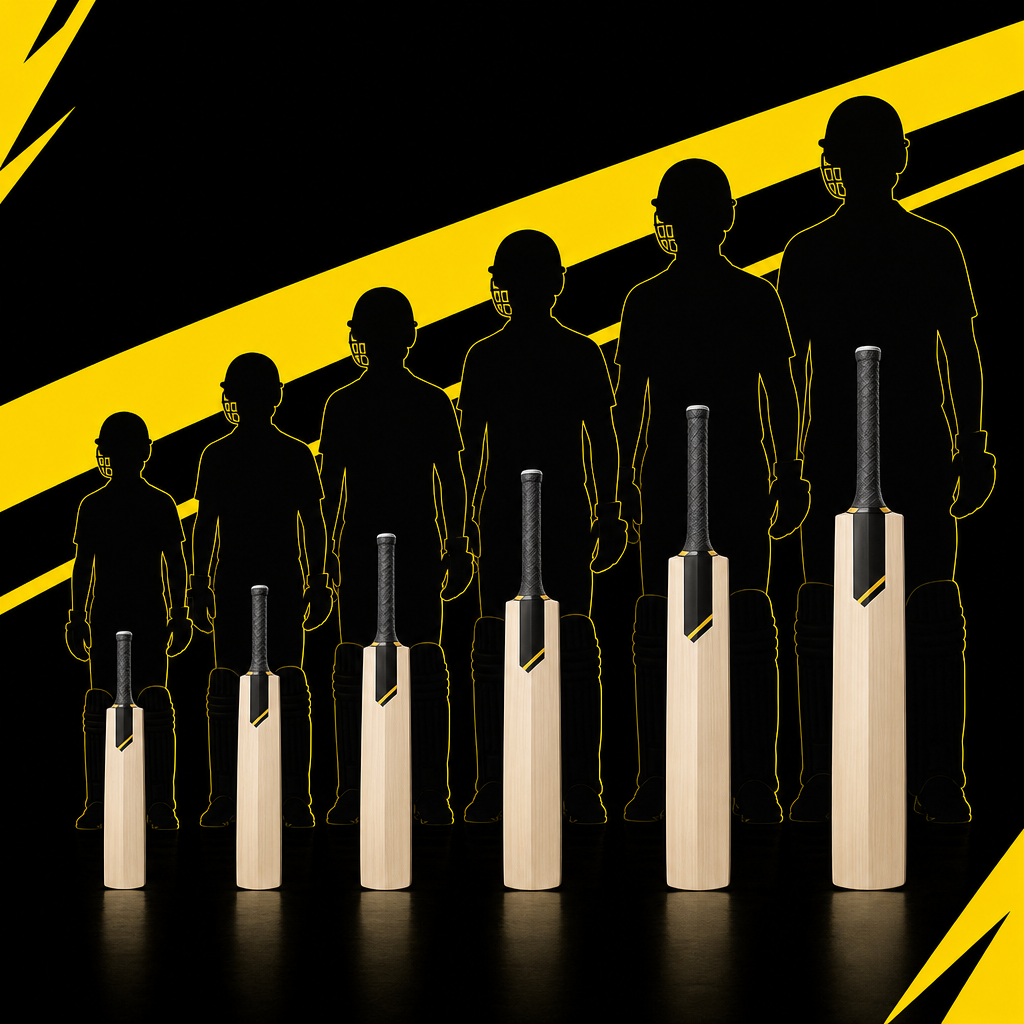
Choose size by standing height first. Juniors move through numbered sizes up to Harrow, then adults step to Short Handle or Long Handle. Use the bands below as general guidance only, because makers differ by a few centimetres and a bat should also feel right in your stance.
The height bands below are common industry conventions, not a regulated standard. Where you sit between two sizes, stance comfort decides.
- Sizes 0 to 3: younger juniors, generally under about 135cm.
- Sizes 4 and 5: roughly 135cm to 150cm.
- Size 6: roughly 150cm to 157cm.
- Harrow: roughly 157cm to 167cm.
- Short Handle (SH): roughly 167cm to 178cm. This is the most common adult size.
- Long Handle (LH): generally above about 178cm.
As a rough rule, the bat should reach about the top of your thigh or the top of your hip when you stand it upright beside your leg. Then check the stance. With the toe of the bat on the ground, your top hand should sit comfortably without you hunching or reaching.
Junior sizes through to Harrow
The common error with juniors is buying a size up so the bat lasts longer. It does not work. An oversized bat drags the swing, forces a low backlift and teaches the wrong habits at the age when technique is being built.
Harrow is the bridge. It is close to a full-size bat in profile but shorter, and it suits teenagers who have outgrown Size 6 but are not yet tall enough for a Short Handle. If your teenager is between sizes, the smaller one is usually the safer choice.
Short Handle vs Long Handle
Short Handle and Long Handle bats differ mainly in handle length, with the blade being similar. The Short Handle is the standard adult bat and suits most players up to around the 178cm mark. The Long Handle adds length to the handle, which suits taller players who would otherwise crouch.
The Laws of Cricket cap the overall bat length at 96.52cm and the blade width at 10.8cm (Law 5, MCC). So every adult bat sits inside the same limits. The difference between SH and LH is how that length is used, and it is not a quality difference.
A taller player can still choose a Short Handle if they prefer a more compact feel, and some do. But if you are tall and find yourself bent over at the crease, move to Long Handle before you blame your technique.
The size decision is also where handedness matters, since bats are made for right-hand and left-hand batters. Make sure the bat you choose matches how you stand.
Cricket Bat Weight Explained: Dead Weight vs Pick-Up
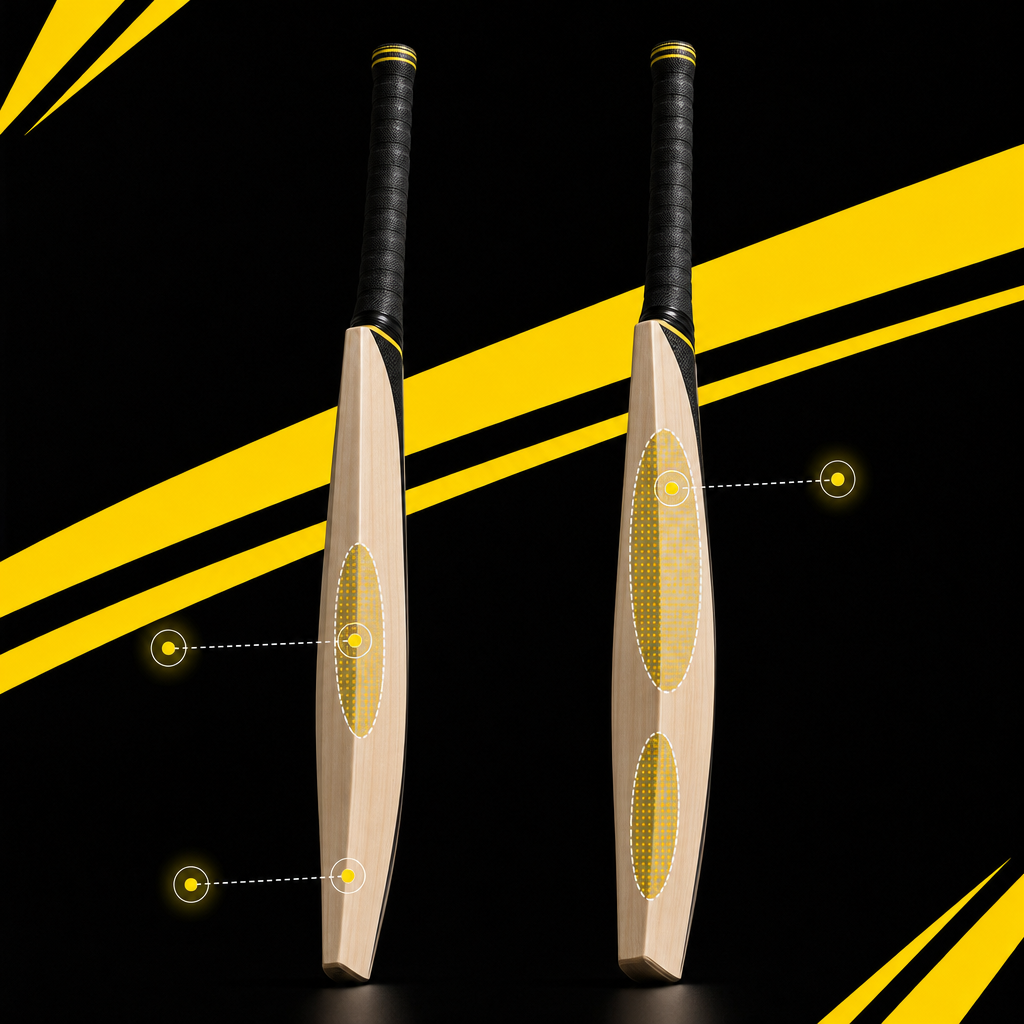
Dead weight is what the bat reads on the scales. Pick-up weight is how heavy it feels when you lift and swing it. Two bats with the same scale weight can feel quite different, because balance, profile and where the wood sits all change how the mass presents in your hands.
This is why "what weight cricket bat should I use" has no single answer. The scale gives you a starting point. Your hands give you the real one.
What changes pick-up weight
Three things matter most:
- Balance point. A bat with more wood concentrated low in the blade feels heavier and more bottom-heavy, even at a modest scale weight. A bat with the weight spread higher or in the shoulders feels lighter and quicker.
- Profile and edges. A bat with thicker edges and a deeper profile carries more wood where it matters, but the wood sits differently. A sleeker profile can feel lighter and be quicker through the swing.
- Sweet spot position. A lower middle tends to feel more compact for drivers. A higher middle can feel lighter in the hands for players who play off the back foot.
A fair summary is that pick-up weight is the feel of the bat when you pick it up and swing it, and it is the number that matters when you are batting.
Typical weight ranges
These are industry conventions for adult English Willow bats, and they are not fixed rules. Adult bats commonly range from about 2lb 6oz to 3lb (roughly 1.1kg to 1.36kg).
- Lightweight: up to about 2lb 8oz. Quicker through the swing and easier to control, which suits many returning players, smaller adults and anyone who bats for long periods.
- Medium: about 2lb 9oz to 2lb 11oz. The most common range for club cricketers and a sensible default.
- Heavy: about 2lb 12oz and above. Suits strong players who already swing late and with timing, usually at a higher standard.
Most adult club players do not need a heavy bat. They need a bat with a good pick-up, and the ranges above are a guide to how to shop, not a target to hit.
Matching the Bat to Your Player Level
Match the bat to your standard of cricket, not to the best bat in the shop. Beginners and social players do well with Kashmir Willow, developing juniors with a lighter bat in a mid-level English Willow grade, and club and representative players with English Willow chosen for the performance they actually need.
Beginner and social players
If you play social cricket or are just starting, Kashmir Willow is a practical choice. It is denser and harder than English Willow, so it is generally heavier, more durable and cheaper. It does not have the same rebound or feel, but at this level you are learning to time the ball, not to extract the last bit of performance.
Developing juniors
A developing junior needs a bat that is the right size and light enough to swing. This is where good advice saves money. A lighter English Willow bat in a middle grade can serve a junior better than a top-grade bat they are not yet strong enough to use. Our separate guide to junior bats goes further on this.
Club grade players
For club cricketers, English Willow is the standard. Here, the questions are weight, pick-up and sweet spot position. Players who bat in the top order and face the new ball tend to prefer a bat that feels controlled. A mid-grade English Willow bat in a medium weight is often the best bat for club cricketers who play most weekends.
Senior and representative players
At senior and representative level, players tend to know what they want. They can use heavier bats, finer profiles and higher grades because their timing is consistent and their bodies are conditioned. Even here, the best bat is the one they can swing freely at the end of an innings.
Where the English Willow grades fit
English Willow bats are commonly sold in grades, from Grade 1 at the top down through lower grades. Grade is mostly about appearance: how straight and even the grain is, and how many blemishes or marks the blade shows. The higher the grade, the cleaner the blade and the higher the price.
Grading is not a measure of how well the bat will suit you. A Grade 1 bat that is too heavy for you will perform worse than a lower-grade bat with a better pick-up. For a developing player, paying for a spotless blade rarely improves their game. Paying for the right weight and balance does.
Matching Weight to Playing Style and Conditions
Front-foot drivers usually suit a bat with a lower middle and balanced pick-up, while back-foot players often prefer a higher middle and a lighter feel. Pitch pace matters too. Hard, bouncy Australian decks reward quick hands and control, while slower club wickets let you carry a little more weight.
Front-foot drivers vs back-foot players
If you score through the V and love to drive, a bat with the middle sitting lower in the blade puts the sweet spot where you meet the ball. The weight should feel balanced, so that the bat comes down on a straight line without effort.
If you pull, cut and play off the back foot, you want a bat that gets up quickly and works around your body. A higher middle and a lighter pick-up help here. A heavy, low-balanced bat can feel slow when the ball is short and quick.
Hard, bouncy decks vs slower club pitches
On hard, bouncy pitches, the ball arrives quickly and at awkward heights. A bat that is light enough to adjust late tends to help, because you need to get on top of bounce, ride it, or get out of the way. Strong players still do well with heavier bats here, but only if their hands are quick.
On slower club pitches, particularly where the ball skids on and gets lower, you often have time to play your shots. A little more weight in the bat can help you hit through the ball when pace is not doing the work. Even so, if you tire late, drop the weight.
Most players do not face one type of pitch. If you play on both, choose for the conditions you face most, and for how your body holds up across a full innings.
A Quick Decision Checklist
Answer five questions before you buy: your height, whether you hold a full stance comfortably, how you score your runs, what pitches you play on, and what you want the bat to do for your level. If any answer is uncertain, choose the lighter and better-balanced option.
- What is my height, and which size band does it fit? Check the maker's chart too, as sizing varies slightly between brands.
- Can I hold a comfortable stance and a normal backlift with this bat? If you hunch, reach or strain, the bat is too long or too heavy.
- How do I score my runs? Front-foot drivers and back-foot players have different needs.
- What pitches do I play on most? Think about pace, bounce and how long you usually bat.
- What level am I playing, and what do I need the bat to do? Match willow type and grade to that, not to the top of the range.
If you are torn between two bats, pick the one that feels lighter in the hand at the end of your practice swings. That is usually the better choice. Once you buy, look after it properly, because a well-maintained bat holds its performance for longer.
Why the Right Bat Is Rarely the Most Expensive One
The biggest issue I see in sporting goods is a market that pushes the premium option first. For cricket bats, that is the wrong order. The best bat is the one that suits your actual level, use case and budget. At Highmark, that has been shaped by real customer conversations with players, coaches, clubs and schools, not by keyword trends.
Here is a simple scenario. Consider a club cricketer who has bought a heavy, top-grade bat because it looked like the serious choice. Early in an innings, it feels powerful. By the second hour, the backlift is dropping, the shots are late and he is hitting across the line. He swaps to a lighter, better-balanced bat in a lower grade. His timing returns, he plays straighter and he lasts longer at the crease. The bat did not get better. It simply got easier to swing.
That is the point most buying guides miss: heavier is not more powerful if you cannot swing it well. Power comes from bat speed and timing. A bat you can swing freely and late into an innings will out-hit a heavier one you are fighting.
The other thing I have seen first-hand is how hard it is to buy an English Willow bat online. Every bat is slightly different in grain structure, weight distribution and pick-up. Many customers hesitated to buy a premium bat without picking it up first. So we introduced a personalised selection process. We share photos, weights and pick-up feedback on shortlisted bats, and we guide customers based on age, playing style and level of cricket.
The results were practical. Interstate customers became more confident buying online, fewer people ended up with unsuitable bats, and we saw plenty of repeat customers and referrals. Honest advice has always done more for us than discounting. If a mid-range bat suits you better than the premium option, we will tell you.
References
- Marylebone Cricket Club (MCC), Laws of Cricket, Law 5 (The Bat): https://www.lords.org/mcc/the-laws-of-cricket
- Cricket Australia, community and junior cricket information: https://www.cricket.com.au
- Kookaburra Sport, manufacturer bat sizing information: https://www.kookaburra.com.au
Find the Right Bat for Your Level
If you are ready to buy, browse the Highmark Cricket bat range filtered by size and grade, with fast dispatch from Melbourne stock. If you are unsure between two sizes or weights, contact the team for honest, level-appropriate advice before you buy. We will help you buy confidently, whether you are a parent buying a first full-size bat or a club player after the best bat for your game.
Frequently asked questions
What weight cricket bat should I use?
Use the heaviest bat you can swing in control for a full innings. For many adult club players, that is a medium weight, roughly 2lb 9oz to 2lb 11oz by common industry convention. Lighter suits smaller or returning players, and heavier suits strong players with consistent timing. Pick-up matters as much as scale weight.
What cricket bat size do I need for my height?
General guidance is Harrow for roughly 157cm to 167cm, Short Handle for roughly 167cm to 178cm and Long Handle above about 178cm. These bands vary by maker, so check the brand's chart and make sure the bat feels comfortable in your stance.
What is the difference between a short handle and a long handle cricket bat?
A Short Handle is the standard adult bat for most players up to around 178cm. A Long Handle has a longer handle and suits taller players who would otherwise crouch. Both sit within the same Laws of Cricket limits on overall length and blade width.
What is pick-up weight in a cricket bat?
Pick-up weight is how heavy a bat feels when you lift and swing it, as opposed to its dead weight on the scales. Balance point, profile and sweet spot position all change it, so two bats of the same scale weight can feel quite different.
Is a Grade 1 English Willow bat better for a club cricketer?
Not automatically. Grade mostly describes how clean and straight the grain looks, not how well the bat suits you. For many club cricketers, a mid-grade English Willow bat with the right size, weight and balance is better value than a top-grade bat that is too heavy.
