




Cricket Bat Guide: Types, Willow Grades, Sizes, Brands, Knocking In and Care Explained

Pick the right cricket bat for your level. Compare English Willow grades, sizes and brands, then learn to knock in and care for it. Advice from Highmark.
A good cricket bat is matched to the player's level, height, budget and how often they play. English Willow suits regular hard-ball players, Kashmir Willow suits beginners and casual use, and juniors need the right size before anything else. For most club cricketers, Grade 2 or 3 English Willow is enough. Knock it in properly before use.
Buying a bat can feel harder than it should. Grades, brands, sizes and prices all compete for your attention, and the marketing usually points to the most expensive option. That is rarely the best place to start.
This guide walks through the decision in the order most buyers face it: what type of bat you need, which willow grade makes sense, what size and weight fit, which brands are worth knowing, and how to prepare and look after the bat once it arrives. It is written for Australian club and grassroots cricketers, and for parents buying for juniors.
Key Takeaways
- Choose the bat type by ball and level first: English Willow for hard-ball cricket, Kashmir for beginners and practice, plastic or tape-ball bats for soft-ball and backyard play.
- Willow grade is mainly a visual rating of grain and blemishes. A Grade 2 or 3 bat often plays very well and costs noticeably less than a top grade.
- Size comes before grade. A bat that is too big or too heavy will hurt technique regardless of how good the willow is.
- No brand is best for everyone. Pick-up, profile and fit matter more than the badge on the blade.
- Oil lightly, knock in properly (commonly 4 to 6 hours with a mallet), then protect the face with an anti-scuff sheet and the toe with a toe guard. Pre-knocked bats still benefit from extra work.
Cricket Bat Guide Summary Table
| Stage of the decision | What to decide | Practical guidance |
|---|---|---|
| Type | English Willow, Kashmir Willow, plastic or tape-ball | Match the bat to the ball and how often you play |
| Grade | Top grade through to lower grades | Mid grades often suit club players best |
| Size | Junior sizes, Harrow, Short Handle or Long Handle | Use the maker's size chart, then check pick-up |
| Brand | Kookaburra, Gray-Nicolls, GM, SS Ton, SG, MRF and others | Compare profile and balance, not just reputation |
| Preparation | Oil, knock in, protect | Do not skip it, even on a pre-knocked bat |
| Care | Storage, light re-oiling, checks | Keep it dry and out of heat |
Cricket Bat Types at a Glance
Cricket bats fall into five practical types: English Willow for serious hard-ball cricket, Kashmir Willow for budget-friendly practice and beginners, junior bats scaled to smaller players, plastic bats for soft-ball and backyard play, and tape-ball bats for tennis-ball cricket. Choose by ball type, how often you play and your level.
| Bat type | Best suited to | Main trade-off |
|---|---|---|
| English Willow | Club, school and competitive hard-ball players | Higher cost and needs proper preparation |
| Kashmir Willow | Beginners, casual players, nets and practice | Denser and generally less responsive |
| Junior bats | Younger players moving into hard-ball cricket | Outgrown quickly, so avoid overspending |
| Plastic bats | Soft-ball, backyard and the youngest players | Not for hard cricket balls |
| Tape-ball bats | Tennis-ball and tape-ball games | Not built for a hard ball |
English Willow is the standard for competitive cricket. It is lighter for its size and more responsive than Kashmir, and the blade can be pressed and shaped for strong performance. It also needs oiling, knocking in and some care. If you play weekly hard-ball cricket, this is where most players end up.
Kashmir Willow is denser and harder. It is durable and priced well, which makes it a sensible first bat or a spare for the nets. It will not feel as lively as English Willow, and that is fine for many beginners. Our separate comparison of English Willow and Kashmir Willow goes into the detail.
Junior bats can be either willow type, scaled in size and weight. The size matters far more than the willow when a child is just starting.
Plastic and tape-ball bats exist for a different game. They suit backyard cricket, school soft-ball sessions and tennis-ball competitions. They are not designed for a hard cricket ball, so never use one in the nets with a real ball.
One rule applies to every bat. According to the MCC Laws of Cricket (https://www.lords.org/mcc/the-laws-of-cricket), the bat's blade must be made of wood, and there are limits on overall length and width. That is why size is about fit, not about buying the biggest legal bat.
English Willow Grades Explained: Grade 1 to Grade 5
English Willow grades rank a blade by how clean and straight its face looks, not by how well it plays. Grade 1 has the straightest grain and fewest blemishes and costs the most. Grade 2 and 3 often hit nearly as well with more visible marks, which is why they suit most club players.
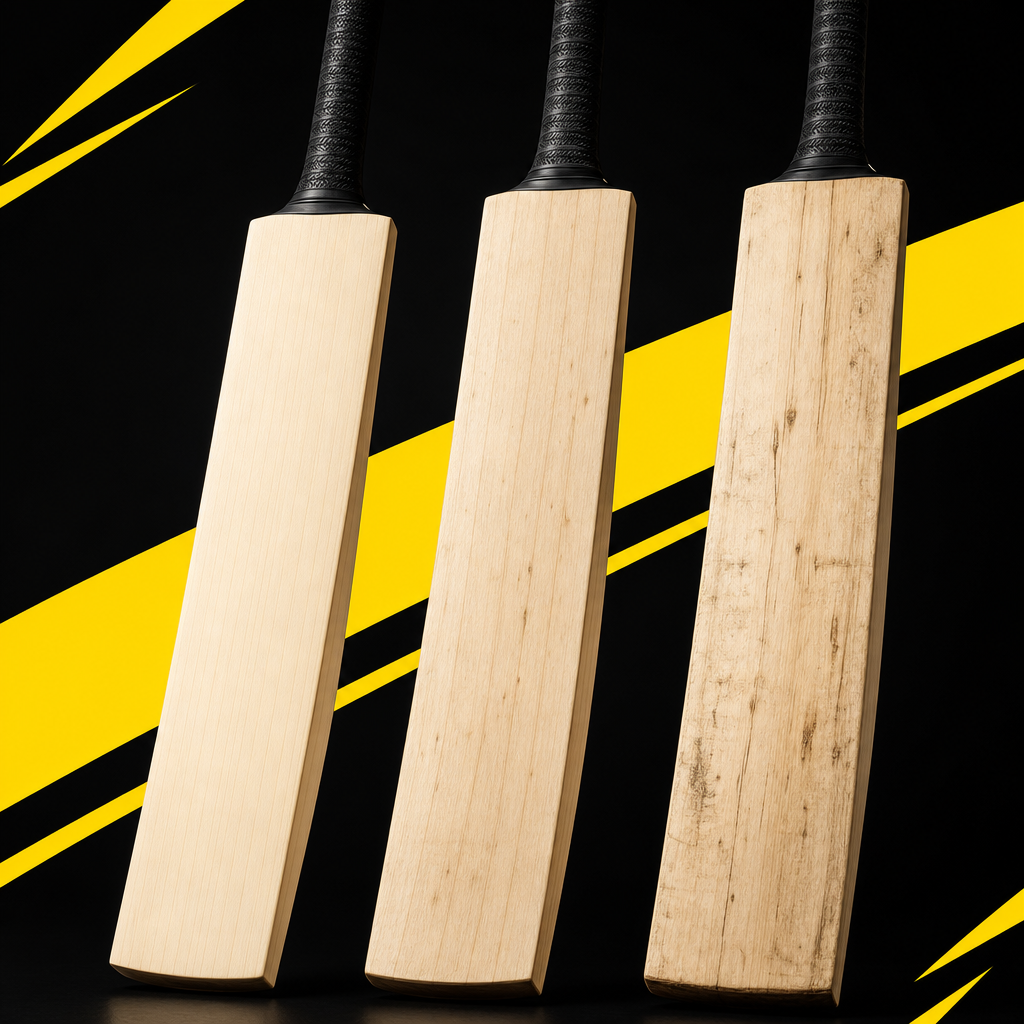
Grading is done by the maker, so there is no single industry standard. One brand's Grade 2 can look different from another's. Treat the labels below as practitioner guidance, not hard data.
| Grade | Grain | Blemishes | Typical performance and use | Price position |
|---|---|---|---|---|
| Grade 1 (top grade) | Straightest, most even grain | Minimal to none | Highest potential, suits elite or very serious players | Highest |
| Grade 2 | Straight grain, slightly less uniform | Small marks or light speckling possible | Excellent for committed club and representative players | High |
| Grade 3 | Mixed grain, some irregularity | More visible marks, edge or face blemishes | Strong everyday club bat, strong value | Mid |
| Grade 4 | Wider, less even grain | Noticeable marks, possible knots or staining | Good for developing players, practice, juniors | Lower |
| Grade 5 and lower | Widest or most irregular grain | Heavy marks, often cosmetic flaws | Entry-level, budget and casual play | Lowest |
What grain and blemishes actually tell you
Grain lines run along the face of the blade. Straight, evenly spaced grain is associated with consistent performance and is the main reason top grades look so clean. Blemishes include butterfly stains, speckling, red marks, knots and small streaks. Many are purely cosmetic. A few, such as knots near the sweet spot, can matter more.
Bat makers also select willow on other qualities such as density, moisture and how well it is pressed. These are not obvious from a photo, which is a good reason to ask about the actual weight and pick-up of any bat you are considering.
Why Grade 2 or 3 often suits club players better
A club cricketer facing a hard ball each weekend gets most of the benefit from a well-made, well-prepared, correctly sized bat. The difference between a Grade 1 and a Grade 2 or 3 is often more visible than it is measurable in a Saturday innings. Meanwhile, the cost gap can fund a second bat, quality protective gear or extra coaching.
The top grade makes sense when you are playing at a standard where marginal gains count and you will look after the bat. For everyone else, it is a premium for appearance and potential you may not use. Grade 4 or 5 is a good fit for younger players who will outgrow the bat quickly, or for anyone who wants a practice bat that can take a beating.
Cricket Bat Sizes and Weight: Junior to Short Handle
Pick the largest bat you can control, not the biggest you can lift. For juniors that means matching size to height using the maker's chart, then checking pick-up. Sizes run from the smallest junior sizes through Harrow to Short Handle, with Long Handle for taller adults.
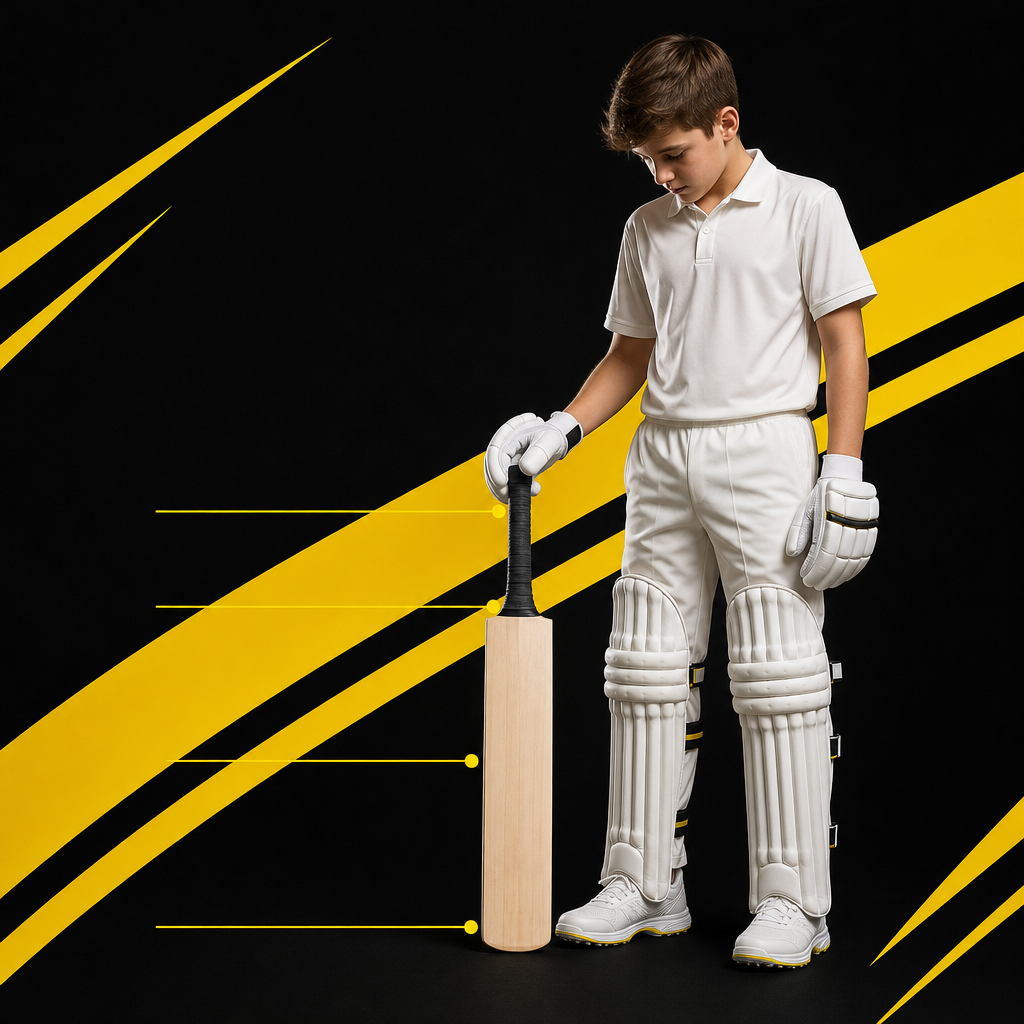
Size labels vary slightly between brands, and the height ranges attached to each size are not identical across makers. Always check the chart for the specific bat. Our Cricket Bat Size Chart goes into the detail brand by brand. According to the MCC Laws of Cricket (https://www.lords.org/mcc/the-laws-of-cricket), a bat cannot exceed 38 inches in overall length or 4.25 inches in width, which is why the sizing system exists for players who are smaller than the legal maximum.
| Size | Who it generally suits |
|---|---|
| Size 0 and Size 1 | The youngest beginners |
| Size 2 and Size 3 | Younger primary-school players learning hard-ball cricket |
| Size 4 and Size 5 | Growing juniors in the middle years of junior cricket |
| Size 6 | Taller juniors approaching adult size |
| Harrow | Older juniors and smaller adults who are not quite Short Handle |
| Short Handle (SH) | The standard adult size for most players |
| Long Handle (LH) | Taller adults who need extra length |
A pick-up weight tip you can test at home
Pick-up describes how heavy a bat feels in the hands once you hold it in your stance, which is not the same as its weight on the scales. Two bats of equal weight can feel very different because the balance point and the profile change how the weight sits in the hands.
Here is a simple test. Hold the bat in your normal stance, take a few defensive blocks and shadow a few straight drives. If the toe drops, your top hand tires or your technique starts to change, the bat is too heavy for you right now. It should feel manageable and balanced, not impressive.
Growing room is a trap
Parents often buy a size up so the bat lasts longer. A bat that is too big pulls a young player into poor habits. They shorten the backlift, drop the bottom hand or fall over the front foot. A correctly sized bat for this season beats a larger bat for next season. If budget is the concern, a Grade 4 or 5 bat in the right size is a better answer than a premium bat in the wrong one.
Best Cricket Bat Brands in Australia and What They Are Known For
No brand is best for everyone. Kookaburra and Gray-Nicolls are names most Australian club players know, GM is a long-established English maker, and SS Ton, SG and MRF are Indian names often chosen for a different profile and pick-up. Compare the specific bat in your hands, not just the logo.
| Brand | Commonly known for | Often suits |
|---|---|---|
| Kookaburra | Australian brand, widely seen in Australian cricket | Players wanting a familiar, trusted range |
| Gray-Nicolls | Long English heritage and strong Australian presence | Club and representative players across levels |
| GM (Gunn & Moore) | Established English maker with a broad range | Players who like traditional shaping |
| SS Ton | Indian brand, often described as strong with thick edges | Power-oriented players who like a fuller profile |
| SG | Indian brand with a wide range from entry to premium | Buyers comparing price across grades |
| Southern Cross | A name in the Australian club market | Value-focused buyers |
| MRF | Indian brand with international player associations | Players wanting a distinct profile |
| Harrow | Also the name of a size between junior and adult | Check whether a listing means the brand or the size |
These descriptions are general, and every bat is slightly different. Two bats from the same brand and grade can differ in grain, weight distribution and pick-up. That is why I would rather you shortlist a few bats and compare real photos and weights than buy purely on brand.
If you want a deeper look at how to compare bats across brands, our guide on how to choose a cricket bat covers it step by step. For younger players, our post on the best cricket bats for juniors narrows the field.
How to Oil and Knock In a Cricket Bat
To prepare an English Willow bat, apply thin coats of raw linseed oil to the face, edges and toe, let it absorb, then knock in with a mallet, commonly for around 4 to 6 hours, building from light to firmer strikes. Finish with an anti-scuff sheet and toe guard before facing a hard ball.
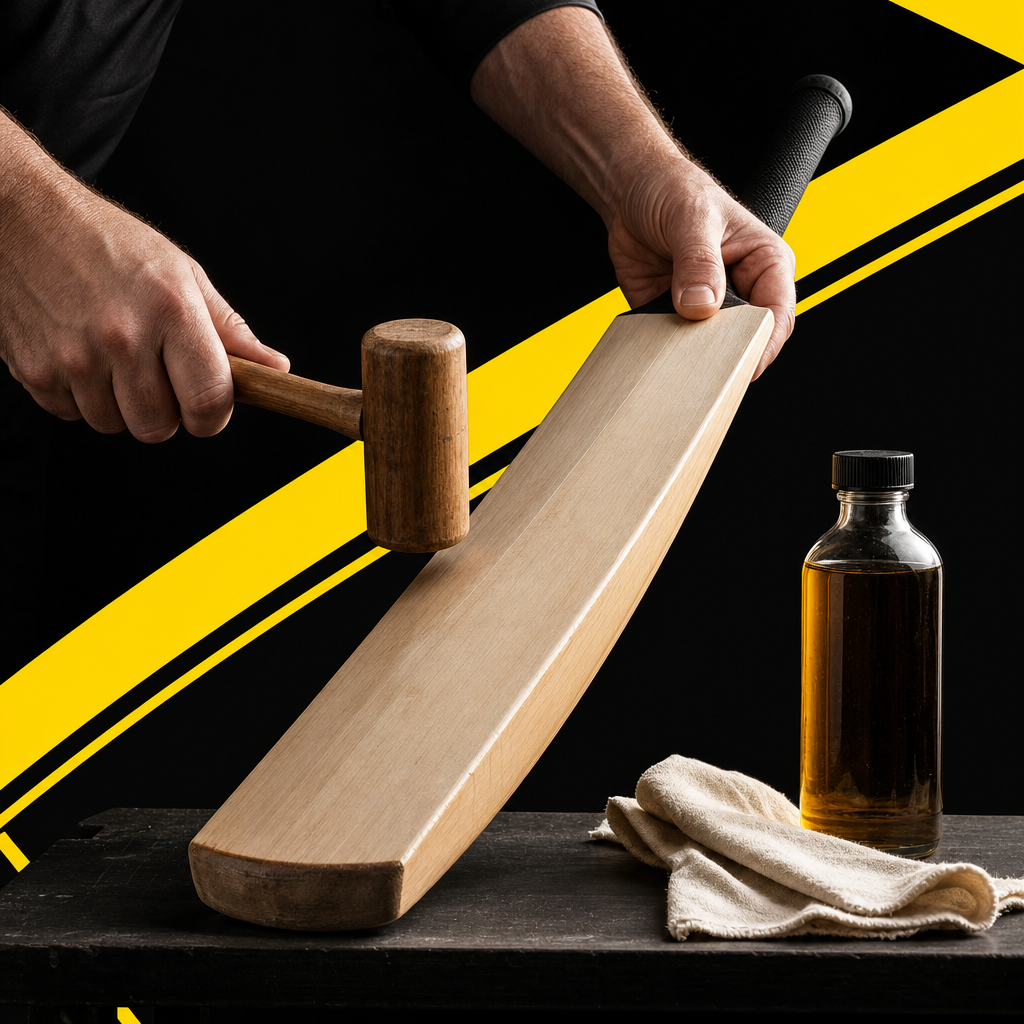
Knocking in compresses the willow fibres so the bat can take the impact of a hard ball without chipping or cracking. Skipping it is the most common reason a good bat gets damaged in its first few matches. The 4 to 6 hour range is a widely used practitioner guide, not a rule. Softer willow or a heavily pressed blade may need more, so go by how the bat feels and looks.
Step 1: Oil the bat lightly
- Use raw linseed oil, not boiled linseed oil.
- Apply a thin coat with a lint-free cloth to the face, edges and toe.
- Keep oil off the splice and handle, and away from stickers.
- Wipe off any excess and let the oil absorb with the bat lying flat.
- Repeat only if the wood still looks dry. Over-oiling makes the blade heavy and dull.
The common mistake is too much oil. A bat should look nourished, not wet.
Step 2: Knock in the face and edges
- Use a proper cricket bat mallet, not a hammer.
- Start with gentle, even strikes across the face, working from toe to shoulder.
- Increase pressure gradually over multiple sessions.
- Work the edges at a slight angle so they round off without splitting.
- Pay attention to the toe, where bats take heavy impact from yorkers.
- Spread the work across several sessions instead of one long block.
As you go, the surface should develop a smooth, slightly darker, compressed look. If you see lifting fibres, stop and ease off before continuing.
Step 3: Test it before match day
Once the mallet work is done, use an old ball in the nets, starting with gentle feeds. Check the edges for dents or fibre lifting. Small surface marks are normal. Anything deeper is worth a closer look.
Step 4: Add protection
Fit an anti-scuff sheet to the face. It guards against scuffs, moisture and wear without changing how the bat plays. A toe guard protects the most vulnerable part of the bat. Make sure the toe is dry before fitting it, so you do not trap moisture inside.
Do pre-knocked bats still need work?
Yes. Pre-knocked is a head start, not a finished job. The work done in a factory or shop varies, and no one knows how your bat will respond to your shots. Give it extra time with the mallet, check the edges and ease into a new bat with softer balls before using it in a match. Kashmir Willow generally needs less preparation than English Willow, but it still benefits from a light oil and some gentle knocking.
Check the maker's warranty terms too. Many state conditions around preparation and use, and following them protects you if something goes wrong.
Cricket Bat Maintenance and Storage
Good maintenance is simple: keep the bat dry, store it away from heat and damp, check the edges and toe regularly, and re-oil only lightly when the wood looks dry. Replace worn anti-scuff sheets and toe guards. Our Cricket Bat Maintenance guide covers the full routine.
A few habits make a big difference to how long a bat lasts:
- Wipe the bat down after use and let it dry naturally.
- Store it at room temperature. A hot car boot or damp shed is a quick way to ruin it.
- Do not leave it standing against concrete or in a wet bag.
- Check the toe and edges before each season and after heavy use.
- Re-oil sparingly, and only if the wood looks dry.
- Replace the anti-scuff sheet when it wears or lifts.
Small hairline surface marks along the grain are common and often harmless. Deeper cracks, splits or a loose splice are worth having checked before you keep playing with the bat.
Quick Decision Pathway: Which Bat Suits Your Level?
Match the bat to your stage. A junior first bat should be correctly sized and affordable, a club bat should balance grade and value, and a senior competitive bat can justify a higher grade if you play regularly and look after it. Start with level, then size, then grade.
Junior first bat
- Check height against the maker's size chart.
- Choose Kashmir Willow or a lower-grade English Willow in the right size.
- Confirm pick-up by having the player hold it in their stance.
- Prepare the bat properly, even if it is a budget model.
Do not buy a premium bat for a player who is likely to outgrow it within a season or two.
Club player
- Decide whether you play weekly hard-ball cricket. If yes, English Willow is the right choice.
- Aim for Grade 2 or 3 as a starting point, and move up only if you can justify it.
- Choose a profile and balance that suit your playing style, whether front-foot or back-foot.
- Budget for oil, a mallet, an anti-scuff sheet and a toe guard.
Senior competitive player
- Higher grades make more sense here, especially if you use the bat in every match.
- Test pick-up with great care, because the margin for error is smaller.
- Consider a spare bat of a similar profile, so a damaged bat does not end your season.
- Invest time in preparation and maintenance.
Why the Top Grade Is Often the Wrong First Choice
The usual advice is that the most expensive bat is the best. After years of talking to players, coaches, clubs and schools, I disagree. The best bat is the one suited to your level and playing style, not just the most expensive option, and grade is only one part of that.
Consider a parent shopping for a young player in their first season of hard-ball cricket. The top-grade bat in the display looks superb, and the price tag makes it feel like a safe, premium choice. But the player is still learning to time the ball, the bat is a touch heavy for them, and they are likely to outgrow it. The better answer is a correctly sized bat in a lower grade, with the savings put towards protective gear. That is the kind of conversation I try to have with every junior customer.
The bigger challenge in our business is online buying. English Willow is a natural product. Every blade has a slightly different grain structure, weight distribution and pick-up, and many customers are understandably hesitant to buy a premium bat they cannot hold. To solve this, we introduced a personalised selection process. We share photos, weights and pick-up feedback on a shortlist of bats, and we guide the customer based on age, playing style and level of cricket.
The result has been much greater confidence in interstate online orders, fewer unsuitable bat purchases and a strong base of repeat customers and referrals. It has reinforced my view that long-term trust comes from product knowledge and honest advice, not just discounts. Fast dispatch from Melbourne stock matters, but it only helps if the bat is the right one.
My practical rule is simple. Decide your level and budget first. Get the size right. Then choose the highest grade you will actually benefit from, and do not feel you have to go beyond that. Grassroots sport is better when people stay in the game, and a well-chosen mid-range bat does that more reliably than an expensive one that does not fit.
Get Honest Advice Before You Buy
Browse Highmark Cricket's English Willow, Kashmir and junior bat range, filtered by level, to see what suits your stage. If you are unsure about grade or size, contact the team before you buy. We will give you honest, practical buying advice so you can buy confidently and get real-world use out of the bat from the first match.
References
- Marylebone Cricket Club (MCC), Laws of Cricket, including the law on the bat: https://www.lords.org/mcc/the-laws-of-cricket
- Cricket Australia, general information on participation and junior cricket: https://www.cricket.com.au
- Gray-Nicolls, manufacturer product information: https://www.gray-nicolls.co.uk
- Gunn & Moore (GM), manufacturer product information: https://www.gmcricket.com
Frequently asked questions
What grade of English Willow is best for club cricket?
For most club players, Grade 2 or 3 is a strong choice. These grades usually offer good willow and solid performance at a lower price than the top grade. Grade 1 makes more sense for very serious players who will notice and use the extra potential.
How long does it take to knock in a cricket bat?
A common practitioner guide is around 4 to 6 hours with a mallet, spread over several sessions. Treat it as a guide, not a hard rule. The bat should feel and look compressed along the edges and face before you use it against a hard ball.
Can I use a cricket bat without knocking it in?
It is not recommended for English Willow. An unprepared bat is more likely to chip, crack or dent when it meets a hard ball. Even pre-knocked bats benefit from extra work, and following the maker's guidance helps protect your warranty.
What size cricket bat does my child need?
Check your child's height against the maker's size chart, then confirm the pick-up by having them hold the bat in their stance. If it feels heavy or alters their technique, go down a size. Avoid buying a size up for growing room.
Is Kashmir Willow good enough for beginners?
Yes. Kashmir Willow is durable and good value, which makes it a sensible first bat or a practice bat. It is denser and less responsive than English Willow, but that rarely holds back a beginner who is still developing technique.
How often should I oil my cricket bat?
Only when the wood looks dry. Over-oiling is a common mistake and can make a bat heavy and dull. Use raw linseed oil in thin coats on the face, edges and toe, and keep it off the splice and handle.
